

Easy Ways To Boost Your Mood This Winter
Winter can be beautiful.
The slower mornings. The cosy evenings. The soup, the blankets, the darker nights, the feeling of turning inward.
But winter can also be really hard.
For many people, the colder months bring a noticeable change in mood, motivation, energy and resilience.
You might feel flatter than usual. You might find it harder to get moving. You might notice the healthy habits you started over summer are slipping.
You might crave more comfort food, sleep longer but still wake tired, feel less social, or notice that your usual healthy habits suddenly feel like more effort.
And if that sounds familiar, you are not alone.
Winter affects your body in several very real ways.
Shorter days mean less daylight exposure. Colder weather often means less movement, more time indoors, and fewer spontaneous social interactions. Sleep routines can shift. Food patterns can change. Stress can feel heavier.
And for some people, this combination can affect the brain chemicals and body rhythms involved in mood, motivation and emotional steadiness.
One of the brain chemicals often discussed in relation to winter motivation is dopamine.
Dopamine is your reward hormone – it is involved in motivation, reward, focus, learning, movement and the feeling of “I’m ready to take action.”
It is not the whole story of mood, and low mood should never be reduced to one chemical, but dopamine is one important piece of the puzzle.
When your light exposure, movement, sleep, nourishment and sense of reward all drop at once, it makes sense that your motivation may feel different too.
The good news is that there are evidence-informed ways to support winter mood.
And they do not require a complete life overhaul.
In fact, the foundations are surprisingly simple:
- Light.
- Movement.
- Sleep rhythm.
- Nourishment.
- Connection.
- Rest.
- Purpose.
Not perfectly. Not all at once. Just consistently enough to give your brain and body the signals they need.

Winter Mood Is Not A Personal Failing
When mood drops in winter, many people blame themselves.
They wonder why they can’t just ‘get motivated’.
They tell themselves they need to exercise more, eat better, go to bed earlier, stop scrolling, be more disciplined, be more positive…
But winter mood is not simply a motivation problem.
Our bodies are rhythmic.
We are designed to respond to light and dark, movement and rest, food and fasting, social connection and solitude. Winter changes many of those inputs at the same time -and when combined with our busy modern lives, it can be a perfect storm.
Less morning light can shift our circadian rhythm, which is the internal body clock that helps regulate sleep, alertness, hormones, appetite, mood and energy.
Traditionally, in winter humans would have gone to bed earlier and woken up with the sun – but artificial lighting, screens, and our environment now plays havoc with our sleep cycles.
Disturbed sleep-wake rhythms are increasingly recognised as an important driver of depression and low mood, so it makes sense that shorter daylight hours have a flow on effect on how we feel. [2]
Colder, wetter weather can also reduce how much we move, and the amount of time we spend in nature. We may drive more, walk less, spend less time outside, and move from one heated indoor space to another – so even if we’re still hitting the gym, our overall (incidental) movement levels go down.
That matters because physical activity is one of the most reliable non-medication supports for mood; while time in nature is a powerful mood booster.
Research suggests that exercise can increase dopamine release in parts of the brain involved in motivation and reward, with brain-derived neurotrophic factor, or BDNF, playing an important role. [1]
A 2026 Cochrane review also found that exercise can be powerful for reducing symptoms of depression [3]
So when our movement levels naturally drop with the shorter colder days, our mood can drop too.
Food patterns also often change in winter.
Fresh food becomes less available and more expensive, meaning many people eat fewer fresh foods, skip breakfast more often, snack more in the afternoon, or rely more heavily on refined carbohydrates and comfort foods.
There is nothing wrong with comfort food occasionally – but if blood sugar is swinging all day, protein is low, or key nutrients are lacking, mood and motivation can become harder to regulate.
Finally, winter can also bring more isolation. People cancel plans. Evenings feel shorter. Social connection can quietly shrink. And loneliness quietly creeps in.
This means winter mood changes are not “all in your head.”
They are in your biology, your environment, your rhythms and your nervous system.
And that is why the answer is also not simply “try harder.”
The answer is to work with your body, and rather than fighting winter, embrace it.

Your Body Is Responding To The Seasons
Winter changes the signals your brain and body receive each day
- Less light
- Less time in nature
- Less incidental movement
- More darkness
- More indoor time
- More comfort eating
- More disrupted routines
- And all too often, more loneliness and less connection
For some people, these changes are mild. For others, they can be enough to affect mood, sleep, energy and motivation in a significant way.
This does not mean you are powerless.
It means you can start by restoring some of the inputs your body relies on: morning light, regular movement, steady meals, sleep rhythm, connection and recovery.
The aim is not to force yourself into a strict winter wellness routine.
The aim is to gently give your body clearer signals.

Start With Light
Morning light is one of the most powerful tools we have for supporting our mood—and it’s completely free.
When natural light reaches our eyes early in the day, it helps set our circadian rhythm, or internal body clock. This supports daytime alertness, healthy melatonin production at night, better sleep quality, and more stable mood and energy.
During winter, many people wake up in the dark, get ready indoors, drive to work or school, and spend much of the day under artificial lighting. Even a brightly lit room is far dimmer than natural daylight outdoors. As a result, we often miss the morning light our body clock relies on to stay well aligned.
Morning light helps signal that the day has begun, while bright light late at night can delay our body clock and make it harder to fall asleep at the right time.
When we don’t get enough morning light, our circadian rhythm can drift later, affecting not only sleep but also alertness, hormone regulation, appetite, mood, and energy levels.
This happens because specialised light-sensitive cells in the retina send signals to the suprachiasmatic nucleus—the brain’s master body clock—as well as other areas involved in alertness, mood, and emotional regulation.[7]
This is why morning light influences much more than sleep timing. It also plays an important role in how energetic, motivated, and emotionally steady we feel throughout the day.
A simple approach during winter is to aim for brighter days and darker nights. What does this mean?
Get outside early.
It does not need to be warm.
It does not need to be sunny.
It does not need to be a long walk.
Even 10–20 minutes of outdoor light early in the morning can be a useful signal for your brain and body.
Then dim household lighting and reduce screen brightness in the evening to help your body prepare for sleep.
You could try:
- standing outside with your morning tea
- walking after school drop-off
- taking your first phone call outdoors
- opening the curtains as soon as you wake
- sitting by a bright window if getting outside is hard
- walking around the block before starting work
For people who experience significant seasonal low mood, or live in places with very short daylight hours, bright light therapy can also be helpful. Typical light therapy recommendations involve a 10,000 lux light box used within the first hour of waking, for around 20–30 minutes, while keeping eyes open but not looking directly into the light. [6]
Light therapy is not right for everyone, and is best discussed with a health professional (especially if you have bipolar disorder, significant eye disease, migraines triggered by light, or medications that increase light sensitivity.)
But for many people, the first step is even simpler:
Get real daylight into your morning, wherever you can.

Protect your sleep rhythm
Sleep and mood are deeply connected.
Poor sleep can worsen mood and motivation [4].
Low mood can then make sleep harder.
Disturbed sleep wake cycles (ie with shorter daylight hours) is also a major driver for depression [5]
This can become a frustrating loop, especially in winter when light exposure is lower and routines may become less consistent.
Many people think about sleep only in terms of hours. But rhythm matters too.
Most adults do best with around 7–9 hours of sleep [5], but your body also likes regularity.
A consistent wake time, morning light, daytime movement and a calming evening routine can all help strengthen the sleep-wake rhythm.
Winter sleep anchors include:
- waking at a similar time most days
- getting outdoor light soon after waking
- keeping caffeine earlier in the day
- eating regular meals
- moving your body during daylight hours
- dimming lights in the evening
- reducing late-night scrolling
- keeping the bedroom cool, dark and quiet
- having a simple wind-down routine
One common winter pattern is the “second wind.”
You feel tired in the evening, push through, scroll or keep working, and then suddenly feel more awake later at night. By the time you get into bed, your nervous system is switched on again.
If this happens, try treating the first wave of sleepiness as a cue.
Go gently. Dim the lights. Lower stimulation. Let the day end.
Sleep is not just a discipline issue either.
It is affected by stress, hormones, alcohol, pain, blood sugar, perimenopause, thyroid function, medications, mood and nervous system activation.
If sleep is persistently difficult — especially if you are regularly awake for long periods, waking very early, feeling panicky at night, or struggling to function during the day — it is worth seeking support.

Move in a Way Your Body Can Say Yes To
Exercise has some of the strongest evidence for supporting mood, and can be a powerful lever to pull in winter when you need a boost.
This does not mean you need to “push harder” or start an intense programme when you already feel depleted.
It means movement is medicine — and the dose can be adapted.
Studies show that exercise may be as effective as psychological or pharmaceutical treatments for helping with depression. [3]
This is because exercise appears to support mood through many pathways.
It can influence endorphins, dopamine, serotonin and other neurotransmitters. It can support neuroplasticity, reduce stress physiology, improve sleep, reduce inflammation, and increase self-efficacy — the feeling that “I can do something that helps.” Lifestyle factors including exercise, nutrition, sleep, inflammation, oxidative stress, stress response and BDNF can all also contribute to depression. [2]
Exercise can increase dopamine release in the striatum, an area involved in movement and reward, with BDNF appearing to play an important role, and benefits lasting for up to a week afterwards. [1].
But this is where we need to be practical.
Research shows optimal benefits come from aiming for 30-60 minutes of aerobic exercise, 3 times per week, for at least 8-12 weeks.
But when your mood is low, the idea of “doing more exercise” can feel impossible.
So the goal initially is not to leap into an intense programme. The goal is to lower the barrier.
In winter, movement might look like:
- a 10-minute walk
- gentle yoga
- strength exercises at home
- walking hills slowly
- dancing in the kitchen
- cycling indoors
- meeting with a friend for a beach or bush walk
- stretching while the kettle boils
- taking the stairs
- doing five squats before a shower, or between meetings
The most helpful movement is the kind that helps you feel good, and that you can repeat.
This is because for mood support, consistency usually matters more than intensity. A gentle walk that happens most days is often more useful than one punishing workout that leaves you exhausted and reluctant to continue.
If you are feeling very flat, start smaller than you think you should.
Two minutes is not nothing.
Five minutes is a vote for your future self.
A helpful question is not, “What workout should I do?”
It is, “What is the smallest movement my body would tolerate today?”
That might be walking to the letterbox. It might be stretching on the floor. It might be putting your shoes on and stepping outside for one minute.
Because motivation often comes after action, not before it.

Feed Your Mind
Food does not necessarily “fix” mood on its own.
But your brain is an energy-hungry organ.
It needs steady fuel, amino acids, fats, vitamins, minerals and a reasonably stable blood sugar environment to function well.
What we eat also impacts levels of inflammation, oxidative stress, and our gut-brain pathways, which in turn are linked with lower mood [5].
But winter can make this harder. Many people crave more refined carbohydrates, skip breakfast, graze more, eat fewer colourful plants and rely on quick comfort foods.
Again, there is nothing wrong with comfort food.
But if you are trying to support mood, energy and motivation, the basics matter.
A mood-supportive winter plate usually includes:
- protein
- fibre-rich unrefined (whole) carbohydrates
- healthy fats
- colourful plants
- iron-rich foods
- zinc-rich foods
- folate-rich greens and legumes
- vitamin D sources or supplementation when appropriate
- omega-3 sources
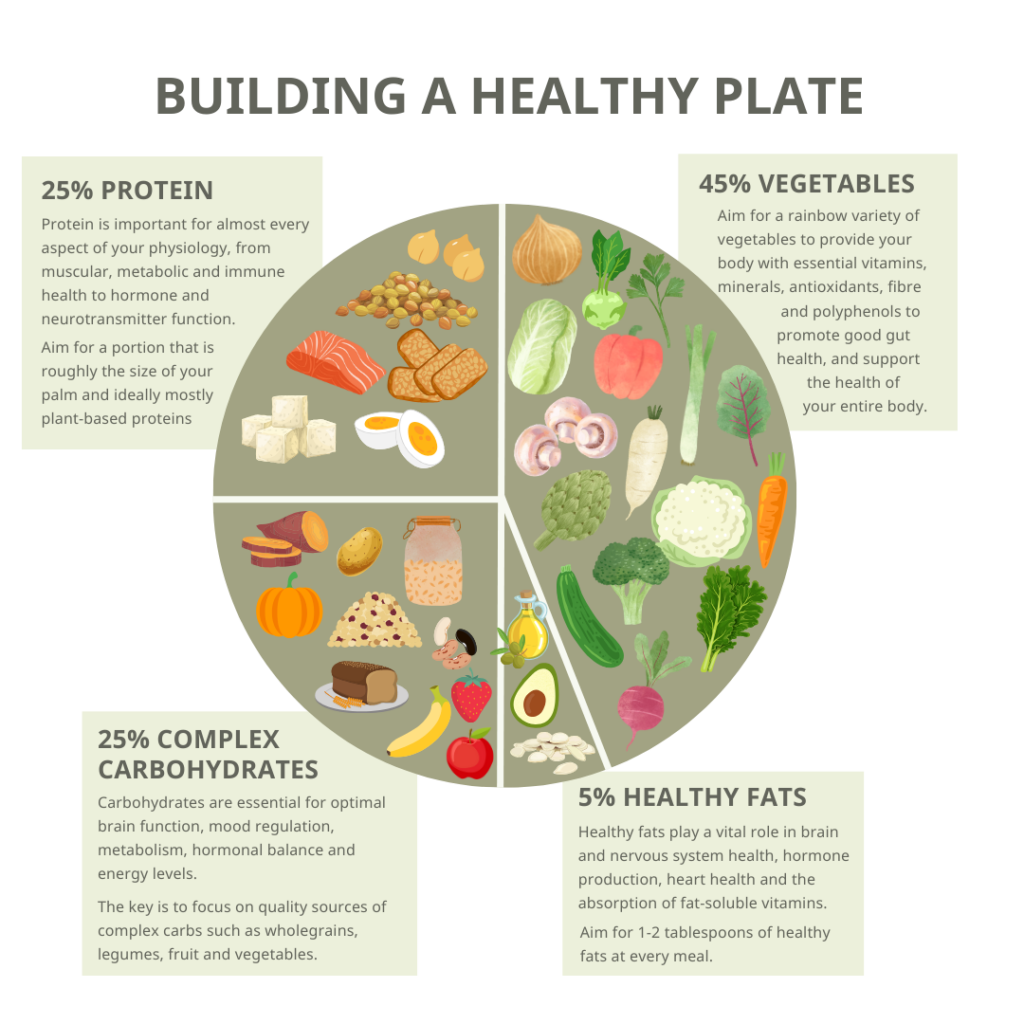
Protein is especially important because amino acids (the building blocks of protein) are needed by our body to build neurotransmitters.
Dopamine, for example, is made from the amino acid tyrosine [8].. This does not mean you need to take tyrosine supplements, and it does not mean more protein is always better. But it does mean that very low protein intake can make mood and energy harder to support
Interestingly, studies show that increasing plant protein can be particularly beneficial for mood – with higher plant protein intake linked with lower rates of depression [9]. This may be due to the presence of fibre in plant proteins – which feed our gut microbiome, and in turn impact our mood [10].
Plant-focused protein options include lentils, chickpeas, beans, tofu, tempeh, edamame, Greek yoghurt, eggs, nuts, seeds and protein-rich whole grains.
For winter mood, breakfast can be a useful place to start.
Skipping breakfast works well for some people, but for others it leads to irritability, low motivation, afternoon crashes or evening cravings.
Simple winter breakfast ideas:
- porridge with Greek yoghurt, chia seeds and berries
- tofu scramble with greens
- eggs on wholegrain toast
- leftover soup with lentils or beans
- smoothie with protein, flaxseed and fruit
- chia pudding with nuts and fruit
- wholegrain toast with hummus and avocado
A useful winter question is:
“Will this meal keep me steady for the next 3–4 hours?”
If the answer is no, try add protein, fibre or healthy fat.
If you’d like to learn more about boosting your mood with food, see our full article here.
Look Beneath the Surface: Key Nutrients to Check
Sometimes winter low mood isn’t just about lifestyle though.
Sometimes the body is missing something important.
Low levels of iron, vitamin B12, folate, vitamin D, or zinc can contribute to fatigue, poor concentration, low resilience, reduced wellbeing, and symptoms that overlap with depression.
They are not the only causes of low mood (and correcting a deficiency is not a guaranteed treatment for depression).
However, they are worth considering—especially if symptoms persist, or if you are vegetarian or vegan, have heavy periods, digestive symptoms, restricted food intake, conditions affecting nutrient absorption, or are in perimenopause.
Folate: Supporting Methylation, Mood and Mental Clarity
Folate is a B vitamin that plays a important role in energy and mood, and low folate levels can worsen fatigue, brain fog, and depression [11].
Good dietary sources include leafy green vegetables, lentils, chickpeas, beans, asparagus, broccoli, avocado, citrus fruits, and fortified foods.
You can easily check folate levels on a blood test, aiming for levels >18nmol/L.
Importantly, folate should never be considered in isolation.
Vitamin B12 deficiency causes very similar symptoms to low folate, and treating folate deficiency without recognising and treating underlying B12 deficiency can be dangerous.[11]
Iron: When Low Iron Feels Like Low Mood
Iron helps your body carry oxygen, make energy and produce important brain chemicals.
When iron stores are low, it’s common to feel exhausted, foggy, short of breath or less able to cope with exercise.
You might also notice restless legs, hair shedding, poor concentration, or low mood [12].
Sometimes it can simply feel like your spark has disappeared.
Ferritin is the blood test most often used to check iron stores, but it needs to be interpreted in context because it can rise during illness or inflammation.
Optimal ferritin levels for women are 50-150 µg/L for women (if there is any concern about inflammation, then this can be checked with a CRP marker)
If your iron is low, the next question is why?
Heavy periods, pregnancy, low dietary intake, blood donation and digestive conditions are all common causes.
Iron supplements aren’t something to take “just in case.”
Finding—and treating—the underlying cause is just as important.
But correcting low levels can be a powerful lever in improving mood [14].
Zinc: The Quiet Multitasker
Zinc doesn’t get much attention, but it’s involved in hundreds of jobs throughout the body, including immune health, wound healing, thyroid function and brain signalling.
Low zinc can impact significantly on mood [15], while correcting zinc levels may help improve depression symptoms [16].
Zinc deficiency is more common in people with gut conditions, restricted diets, high alcohol intake or problems absorbing nutrients.
Pumpkin seeds, legumes, nuts, eggs, dairy and whole grains are all good sources.
If you eat mostly plant foods, soaking, sprouting or fermenting grains and legumes can help improve zinc absorption.
Optimal zinc levels are 12–18 µmol/L), however zinc testing isn’t perfect, and doesn’t always reflect total body zinc.
It can be helpful if you are worried about deficiency though – results are best interpreted alongside your overall health rather than on their own.\
Vitamin B12: More Than an Energy Vitamin
Vitamin B12 keeps your nerves, brain and blood cells healthy.
When levels are low, people can often notice fatigue, brain fog, poor memory, low mood, numbness or tingling, and sometimes balance changes [17].
Vegetarians, vegans, older adults, and people taking metformin or acid-suppressing medications are at higher risk [18].
Optimal B12 for brain health and mood is >300-400 pmol/L; if levels are borderline, additional tests such as active B12, methylmalonic acid (MMA) or homocysteine can sometimes help identify a functional deficiency [18].
Because folate and vitamin B12 work closely together, it’s important to make sure both are adequate.
Treating folate deficiency alone can mask an underlying B12 deficiency, allowing nerve damage to progress [18].
Vitamin D: The Winter Vitamin
Vitamin D is made when sunlight reaches our skin, so it’s no surprise that levels often fall during winter.
Although it’s best known for supporting bone health, vitamin D also plays important roles in immune function, mood, energy, and overall wellbeing [19].
While blood tests can help guide whether supplements are needed, not everyone needs to be tested – in many cases, your doctor may recommend supplementation based on your risk factors rather than a blood test.
If you spend very little time outdoors, have darker skin, are older, have a condition affecting absorption, or live somewhere with limited winter sunshine, it’s worth discussing vitamin D with your healthcare provider.
Supplementing at 4000-5000iu/day appears to have the strongest impact on mood [20] in people with depression, however vitamin D is toxic in high doses, so more is not always better!
In practice, if you’re supplementing, and want to ensure you’re doing so at a safe level, a single vit D level during winter can be useful to check.
Vitamin D also won’t fix low mood on its own—but correcting a deficiency is an important part of supporting your health.

Notice What’s Draining You
Supporting mood is not only about adding more healthy habits.
Sometimes it is about reducing what is draining you.
Winter drains can include:
- too much sitting
- too much scrolling
- too much news
- too much alcohol
- too little daylight
- too little connection
- too little recovery
- too many evenings spent “numbing” rather than resting
There is a difference between true rest and low-quality collapse.
True rest leaves you a little more restored. Low-quality collapse often leaves you more depleted, foggy or disconnected.
This does not mean you need to become perfectly disciplined. It just means noticing what genuinely helps you feel steadier.
For example:
- Does scrolling at night help, or does it delay sleep?
- Does alcohol relax you, or does it worsen 3am waking?
- Does skipping breakfast give you energy, or does it trigger a crash?
- Does staying indoors all day protect your energy, or does it make you feel flatter?
- Does cancelling every plan help you recover, or does it increase isolation?
Winter often asks for gentleness.
But gentleness is not the same as disappearing from your own life.

Build connection and small moments of reward
Dopamine is not only about productivity.
It is also involved in reward, learning and anticipation.
In winter, many of the small rewards of life can shrink: sunshine, evening walks, spontaneous catch-ups, time outside, easy movement, social energy.
So it can help to deliberately build small moments of reward into the week.
Not huge plans. Not expensive outings. Just small things your brain can look forward to:
- A walk with a friend.
- A new soup recipe.
- A winter playlist.
- A Sunday morning swim.
- A library visit.
- A creative project.
- A yoga class.
- A phone call with someone safe.
- A family movie night.
- A walk somewhere beautiful.
Mastery also matters.
Learning something new, practising a skill, finishing a small project or returning to a hobby can help restore a sense of agency, and boost mood.
Low mood often tells us, “Nothing will help.”
But small experiences of connection, pleasure and completion can gently challenge that message.
Use the “minimum effective dose” approach
When people feel low, overwhelmed or exhausted, wellness advice can become another burden.
So rather than aiming for the perfect winter routine, try the minimum effective dose.
Ask:
What is the smallest version of this habit that still counts?
- For light: stand outside for two minutes.
- For movement: walk to the end of the street.
- For food: add protein to breakfast.
- For sleep: dim lights 30 minutes earlier.
- For connection: send one text.
- For rest: lie down without your phone for five minutes.
This approach works because it lowers resistance – it feels easier and more acheivable.
Remember – you are not trying to become a new person overnight.
Small habits are not small when they are repeated.

Your simple winter mood reset plan
Here is a practical seven-day reset you could try.
Day 1: Morning light
Get outside within an hour of waking, even briefly.
Day 2: Add protein to breakfast
Notice whether your mood, cravings or afternoon energy change.
Day 3: Move for 10 minutes
Walk, stretch, dance or do gentle strength work.
Day 4: Create an evening dim-down
Reduce bright light and screens before bed.
Day 5: Eat one extra colourful plant food
Greens, lentils, berries, pumpkin, citrus, broccoli or whatever is realistic.
Day 6: Connect with someone
Send the message. Make the call. Walk with a friend.
Day 7: Review your energy
Ask: What helped even a little? What felt too hard? What is worth repeating?
The point is not perfection.
The point is pattern.

When to seek more support
Winter mood changes are common, but persistent low mood should not be ignored.
Please seek professional support if you are experiencing:
- low mood most days
- persistent loss of interest or pleasure
- feelings of hopelessness
- significant anxiety or panic symptoms
- difficulty functioning
- major sleep or appetite changes
- thoughts of self-harm
- feeling like life is not worth living
In New Zealand, you can call or text 1737 any time for free, confidential support from a trained counsellor or peer support worker. Your GP practice can also help.
If you or someone else is in immediate danger, call 111.
You deserve support.
You do not have to wait until you just can’t go on.

The bottom line
Winter can make mood feel harder.
Not because you are weak.
Not because you are lazy.
Not because you lack discipline.
But because your biology is responding to less light, less movement, changed rhythms, different food patterns, colder weather and often less connection.
The solution is not to shame yourself into doing more.
The solution is to come back to the foundations.
- Get light early.
- Move gently and often.
- Protect your sleep rhythm.
- Eat enough protein and plants.
- Check key nutrients if symptoms persist.
- Reduce what drains you.
- Build small moments of connection and reward.
You do not need a perfect winter routine.
You need a few steady anchors, repeated often enough that your body starts to trust them.
And sometimes the most powerful place to begin is very simple:
- Open the curtains.
- Step outside.
- Take a breath.
- Move your body for two minutes.
- Eat something nourishing.
- Go to bed a little earlier.
- Text someone who feels safe.
Small things count.
Especially in winter.
You deserve to feel better.
References:
- Guendalina Bastioli, Jennifer C. Arnold, Maria Mancini, Adam C. Mar, Begoña Gamallo-Lana, Khalil Saadipour, Moses V. Chao, Margaret E. Rice. Voluntary Exercise Boosts Striatal Dopamine Release: Evidence for the Necessary and Sufficient Role of BDNF. Journal of Neuroscience 8 June 2022, 42 (23) 4725-4736; DOI: 10.1523/JNEUROSCI.2273-21.2022
- Clegg AJ, Hill JE, Mullin DS, Harris C, Smith CJ, Lightbody CE, Dwan K, Cooney GM, Mead GE, Watkins CL. Exercise for depression. Cochrane Database of Systematic Reviews 2026, Issue 1. Art. No.: CD004366. DOI: 10.1002/14651858.CD004366.pub7. Accessed 04 July 2026.
- Budde H, Dolz N, Mueller-Alcazar A, Schacht F, Velasques B, et al. (2025) A 10 years update of effects of exercise on depression disorders—in otherwise healthy adults: A systematic review of meta-analyses and neurobiological mechanisms. PLOS ONE 20(5): e0317610. https://doi.org/10.1371/journal.pone.031761
- Zhenping Jiang, Bum-Young Park, Association of physical activity, sedentary behavior, and sleep duration with major depressive disorder: a cross-sectional and Mendelian randomization study. Journal of Affective Disorders, Volume 392, 2026, 120309, ISSN 0165-0327, https://doi.org/10.1016/j.jad.2025.120309.
- Kunugi, H. (2023), Depression and lifestyle: Focusing on nutrition, exercise, and their possible relevance to molecular mechanisms. Psychiatry Clin. Neurosci., 77: 420-433. https://doi.org/10.1111/pcn.13551
- https://www.mayoclinic.org/diseases-conditions/seasonal-affective-disorder/in-depth/seasonal-affective-disorder-treatment/art-20048298
- Murukesu RR, Alkaff ZA, Bridges C, Spitschan M. Ocular light exposure interventions for sleep, circadian rhythms, rest-activity cycles, mood, and cognitive function in older adults: An Overview of Cochrane and non-Cochrane Systematic Reviews. Cochrane Database Syst Rev. 2025 Sep 12;9(9):CD016157. doi: 10.1002/14651858.CD016157. PMID: 40937968; PMCID: PMC12427608.
- Jongkees BJ, Hommel B, Kühn S, Colzato LS. Effect of tyrosine supplementation on clinical and healthy populations under stress or cognitive demands–A review. J Psychiatr Res. 2015 Nov;70:50-7. doi: 10.1016/j.jpsychires.2015.08.014. Epub 2015 Aug 25. PMID: 26424423.
- Fotouhi Ardakani A, Shirdeli M, Khorvash F, Hajhashemy Z, Askari G. Association Between Total, Animal, and Plant Protein Intake and Risk of Depression in Adults: A Systematic Review and Dose-Response Meta-Analysis of Observational Studies. Nutr Rev. 2026 Mar 31:nuaf314. doi: 10.1093/nutrit/nuaf314. PMID: 41914712.
- https://www.mayoclinic.org/diseases-conditions/vitamin-deficiency-anemia/symptoms-causes/syc-20355025
- Zeng W, Ma H, Wei S, Li H, Jin Z, Zhou L, Chai S, Tan Y, Tang G, Wei H. Red blood cell folate and depression risk in U.S. women: A dose-response analysis from a nationwide cross-sectional study (2009-2018). Medicine (Baltimore). 2026 Mar 13;105(11):e48023. doi: 10.1097/MD.0000000000048023. PMID: 41824854; PMCID: PMC12991464.
- Selhub J, Morris MS, Jacques PF, Rosenberg IH. Folate-vitamin B-12 interaction in relation to cognitive impairment, anemia, and biochemical indicators of vitamin B-12 deficiency. Am J Clin Nutr. 2009 Feb;89(2):702S-6S. doi: 10.3945/ajcn.2008.26947C. Epub 2009 Jan 13. Erratum in: Am J Clin Nutr. 2009 Jun;89(6):1951. PMID: 19141696; PMCID: PMC2647758.
- Fiani D, Chahine S, Zaboube M, Solmi M, Powers JM, Calarge C. Psychiatric and cognitive outcomes of iron supplementation in non-anemic children, adolescents, and menstruating adults: A meta-analysis and systematic review. Neurosci Biobehav Rev. 2025 Nov;178:106372. doi: 10.1016/j.neubiorev.2025.106372. Epub 2025 Sep 11. PMID: 40945632.
- Wang, X., H. Chen, Z. Chang, J. Zhang, and S. Cao. 2025. “The Potential Role of Serum Iron in Depression: Further Exploration of Future Research Directions.” Journal of Clinical Psychology82: 359–375. https://doi.org/10.1002/jclp.70058.
- Swardfager W, Herrmann N, McIntyre RS, Mazereeuw G, Goldberger K, Cha DS, Schwartz Y, Lanctôt KL. Potential roles of zinc in the pathophysiology and treatment of major depressive disorder. Neurosci Biobehav Rev. 2013 Jun;37(5):911-29. doi: 10.1016/j.neubiorev.2013.03.018. Epub 2013 Apr 6. PMID: 23567517.
- Yosaee S, Clark CCT, Keshtkaran Z, Ashourpour M, Keshani P, Soltani S. Zinc in depression: From development to treatment: A comparative/ dose response meta-analysis of observational studies and randomized controlled trials. Gen Hosp Psychiatry. 2022 Jan-Feb;74:110-117. doi: 10.1016/j.genhosppsych.2020.08.001. Epub 2020 Aug 10. PMID: 32829928.
- Sahu P, Thippeswamy H, Chaturvedi SK. Neuropsychiatric manifestations in vitamin B12 deficiency. Vitam Horm. 2022;119:457-470. doi: 10.1016/bs.vh.2022.01.001. Epub 2022 Mar 3. PMID: 35337631.
- https://www.aafp.org/afp/2025/0900/vitamin-b12-deficiency
- Ronaldson A, Arias de la Torre J, Gaughran F, Bakolis I, Hatch SL, Hotopf M, Dregan A. Prospective associations between vitamin D and depression in middle-aged adults: findings from the UK Biobank cohort. Psychol Med. 2022 Jul;52(10):1866-1874. doi: 10.1017/S0033291720003657. Epub 2020 Oct 21. PMID: 33081855; PMCID: PMC9340850.