

Setting Intentions: How Clarity, Emotion, and Science Merge to Create Change
In a world that constantly pulls our attention outward—towards productivity metrics, comparison, and external expectations—it’s easy to feel disconnected from what truly matters to us.
Many people sense that they want change, yet struggle to translate that desire into sustained action.
This is where intention-setting and vision boards come in—not as mystical shortcuts or wishful thinking, but as practical tools that work with the brain, nervous system, and human behaviour.
Intentions provide direction, while vision boards keep that direction emotionally alive and visible.
One clarifies how you want to live; the other helps you feel it often enough that your choices begin to align naturally.
But how do these actually work? Is there science to back them up?
In this article, we’ll explore:
- What intentions are (and what they are not)
- How to set intentions that actually guide behaviour
- How to create a vision board that works psychologically, not just aesthetically
- The science behind why these practices can be effective
- How to integrate them into real life without pressure or perfectionism
So please read on if you’re curious, and would like to know more!

What “setting intentions” really means
An intention isn’t just a vague concept – it is a deliberate statement about how you choose to live, act, or relate, rather than a specific outcome you want to achieve.
While goals focus on results, intentions tie into the deeper values that hold meaning and value for us.
For example:
- Goal: “I want to lose 10 kilograms.”
- Intention: “I intend to treat my body with consistency, respect, and patience, so I can do the things I love.”
- Goal: “I want to get promoted.”
- Intention: “I intend to approach my work with curiosity, courage, and integrity, to feel fulfilled and valued.”
Both goals and intentions have merit, but they operate very differently in the brain.
Goals are often time-bound and externally measurable – meaning if we don’t reach them when we hope to, we can easily lose motivation, and give up.
Intentions, by contrast, guide moment-to-moment decision-making, and do not rely on acheiving external results.
This distinction matters because much of life is unpredictable. Outcomes change. Timelines shift. Circumstances evolve. Intentions give you something stable to return to—even when the original plan no longer fits.
Rather than asking, “Am I achieving this yet?”, intentions ask:
- How am I showing up today?
- Are my actions aligned with what matters to me?
This makes intentions particularly powerful during transitions, uncertainty, or periods of stress—when rigid goal-setting can feel overwhelming or discouraging.
Why intentions work differently from goals
From a psychological perspective, intentions:
- Emphasise values, which are more enduring motivators than external rewards
- Encourage self-concordant behaviour (action that align with personal meaning)
- Reduce the all-or-nothing mindset that often accompanies goal failure
And science backs this up – with research showing that people are more likely to sustain behaviour change when actions are connected to intrinsic values rather than purely external outcomes.
Intentions also support self-compassion. If you miss a workout, set a boundary late, or take a wrong turn, rather than beating yourself up or feeling like a failure, the question becomes:
- “What can help me realign with my intention?”
Not:
- “I’ve failed—what’s wrong with me?”
This subtle shift reduces shame and increases resilience.
How to set powerful intentions that work
Rather than rushing through intention-setting as a New Year’s exercise, it helps to approach it as a brief reflective ritual. This signals to the brain and nervous system that this process matters.
1. Pause and reflect honestly
Start by bringing awareness to your current life.
Ask yourself:
- Which areas feel supportive, nourishing, or alive?
- Which areas feel heavy, stagnant, or draining?
Common life domains include:
- Physical health
- Emotional wellbeing
- Relationships
- Work or finances
- Creativity
- Rest and play
- Spiritual or existential meaning
We often use the bullseye concept below as a framework.
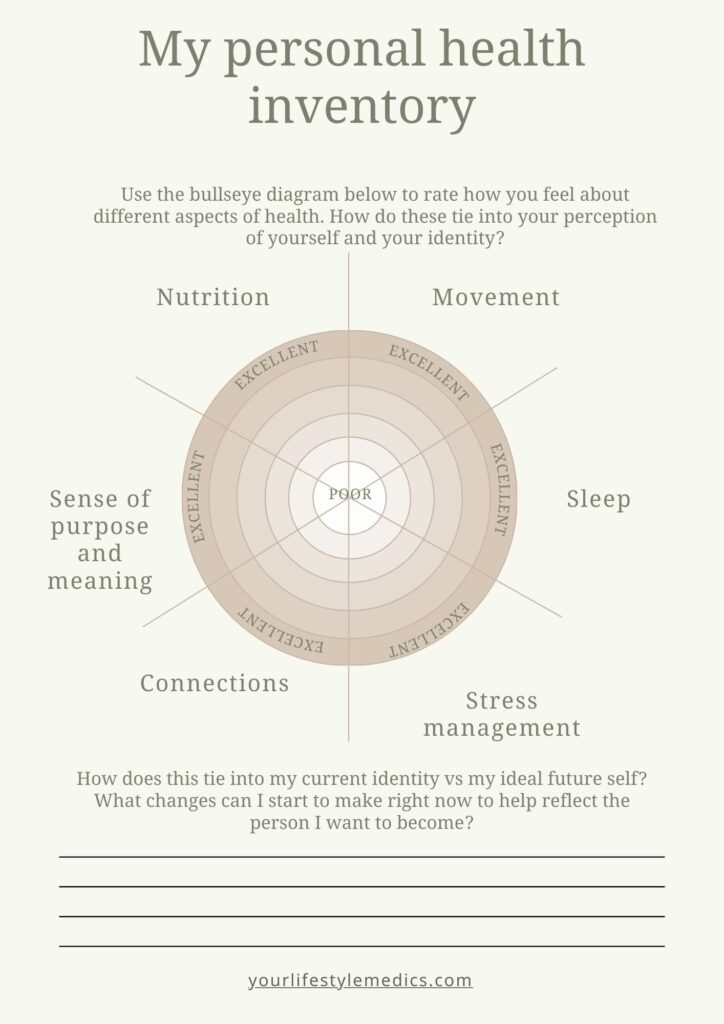
Importantly, notice what you feel drawn to change—not what you think you should want, or what social media, family, or culture tells you to prioritise.
This step alone can be deeply clarifying.
2. Begin with the end in mind—emotion first
Next, imagine one of these areas feeling aligned 6–12 months from now.
Rather than focusing on external achievements, ask:
- How would I feel in my body?
- What would my nervous system feel like day to day?
- What qualities would be present in how I move through life?
Words that often emerge here include:
- Calm
- Grounded
- Spacious
- Energised
- Free
- Connected
- Confident
- Fulfilled
- Vibrant
- Steady
Emotion is key. The brain is far more responsive to emotional imagery than abstract logic.
3. Translate insight into intention statements
Once you have clarity, turn it into a short, present-tense statement.
Effective intentions are:
- Simple
- Value-based
- Flexible
- Oriented towards behaviour, not perfection
Examples:
“I intend to move through my days with steadiness and self-respect.”
“I choose to prioritise rest without guilt.”
“I am committed to communicating honestly and kindly.”
Avoid language that feels harsh, rigid, or performative. If the intention feels heavy or overwhelming, it may be too outcome-focused.
4. Check for authenticity and alignment
Before finalising an intention, ask:
- Does this genuinely feel like mine, or is it someone elses?
- Does it reflect my values—or external pressure?
A strong intention often feels:
- Honest
- Slightly stretching, but not too much
- Calm rather than frantic
If it triggers anxiety or self-judgment, refine it to make it feel more manageable.
Remember – choose an intention that feels right for where you are right now – not where you think you should be.
5. Keep intentions flexible and alive
Intentions are not fixed contracts. They evolve as you do.
Many people find it helpful to hold:
- One overarching intention for a season or year (e.g. “connection,” “ease,” “clarity”)
- A few supporting intentions for different areas of life
Revisiting and refining intentions regularly keeps them relevant and supportive, rather than rigid or aspirational.

What a vision board is —and why it works
A vision board is a visual representation of your intentions, values, and desired emotional states, created using images, words, and symbols.
Its purpose is not to “manifest” outcomes magically, but to help:
- Focus attention
- Evoke emotion
- Reinforce meaning
- Support consistent, aligned action
Humans are highly visual beings. Images communicate directly with emotional and memory centres in the brain, bypassing the need for analytical processing.
This is why a well-crafted vision board can feel powerful—even when you intellectually “know” it’s just paper or pixels.
How to create a vision board (step by step)
1. Clarify your timeframe and themes
Choose a timeframe—often 6 or 12 months—and identify a few key life areas, such as:
- Health
- Work or finances
- Relationships
- Personal growth
- Creativity or joy
- Rest or spirituality
For each area, write down one or two intentions or desired feelings.
2. Choose your format
You can create a vision board in physical or digital form.
For physical boards, you need:
- Poster board or corkboard
- Magazines or printed images
- Scissors, glue, tape, pens
- Small meaningful objects or textures
To create digital boards, you can use programs such as:
- Canva
- Desktop or phone wallpaper collages
Choose the format you’re most likely to use, and to see regularly.
3. Select images that evoke feeling
This is the most important step.
Look for images that feel like your intention, rather than literal depictions of goals.
For example:
- A person laughing on a beach might represent freedom and vitality
- A softly lit room might symbolise rest and safety
- A winding path could represent patience or trust
If an image makes you pause or feel something in your body, it’s doing its job.
4. Add words and phrases sparingly
Words can reinforce meaning when used intentionally, but the aim for vision boards is to evoke emotion and mental images, rather than intellectual concepts.
Consider:
- Single words (ease, courage, grounded)
- Short affirmations
- Simple phrases that resonate emotionally
Avoid clutter. Less is often more.
5. Arrange intuitively
There is no “correct” layout. The aim is to find a layout that resonates, and feels right to you.
You might choose to:
- Cluster images by life area
- Place your main intention at the centre
- Let the design flow organically
As you place each image, pause briefly and imagine living that experience. Notice what arises in your body.
This moment of embodied visualisation strengthens the board’s impact.
6. Anchor meaning with ritual
Consider:
- Creating the board in a quiet, reflective space
- Lighting a candle or play calming music as you make it
- Writing your primary intention/s clearly somewhere on the board
Ritual helps signal significance, clarity, and calm to your nervous system.
7. Place and use your board intentionally
Put your vision board somewhere you’ll see it often:
- Near your bed
- Above your desk
- As a phone or laptop background
Spend a few moments with it most days—not to “wish,” but to reconnect, and visualise what your intentions could look like in your future life.
Each time you look at it, try make a habit of asking yourself:
- What small action can I take today that aligns with this?
- How can I embody this intention now in my life?

The science behind intentions and vision boards
These practices aren’t just ‘nice to do’ – they have proven real benefits to our wellbeing. Next we’ll dive into the science of how they work – this section gets a bit technical, but it’s absolutely intriuging if you like knowing how things work!
Psychology and neuroscience research shows us that intention setting changes our brain via the following pathways:
1. Attention and the brain’s filtering system (RAS)
Setting an intention does more than clarify what you want—it literally changes how your brain processes the world.
Your brain is constantly filtering out information to prevent it becoming overloaded. This filtering system is wired for survival – to prioritise what seems most relevant to your current situation and concerns.
At the center of this process is our brain’s attentional system.
A structure called the thalamic reticular nucleus acts like an gate, regulating which information reaches the main part of our brain, the cortex.
Did you know that only a fraction of what you see, hear, or feel is actually allowed through into our conscious attention—and that selection is strongly influenced by what matters to you at the moment?
Information that is relevant to your goals is prioritized, while distractions are filtered out.
This filtering isn’t accidental either.
Your prefrontal cortex, the ‘command centre of your brain’, working together with your thalamus and basal ganglia, then applies top-down control over your perception.
In simple terms, this means that your goals and intentions tell your brain exactly what to pay attention to, and what to filter out or discard.
When you set a clear intention, you provide your brain with specific operating instructions for what should be amplified and what can safely be ignored.
On a larger scale, intention setting reorganizes how your entire brain network works together.
Goal-directed attention recruits areas called the frontoparietal and dorsal attention networks, which help focus your attention on the things around you that support your aims.
This means when something is genuinely important to you, or you have set it as an intention, you’re more likely to notice opportunities, remember relevant details, and recognize choices that help move you in the right direction.
In other words, intention doesn’t bend reality—but it does shape perception.
This is the same mechanism behind noticing a particular car everywhere once you’re thinking of buying one, or noticing babies everywhere if you’re thinking about trying to get pregnant. It isn’t co-incidence – it’s your brain deliberately noticing and focusing on what is in your conscious (or subconscious) mind.
Intention setting works because the brain is designed to align attention with purpose, turning clarity into momentum.
2. Neuroplasticity and mental rehearsal
Neuroplasticity is your brain’s ability to change itself over time.
Rather than being fixed after childhood, as was once thought, your nervous system has an amazing ability to adapt throughout life, constantly rewiring itself in response to learning, behavior, and environment.
This capacity for change is one of the foundations of learning, memory, and recovery—and it’s central to how intention setting creates lasting effects.
Modern brain imaging has made this concept tangible.
Studies using functional magnetic resonance imaging (fMRI) show that the adult brain can undergo measurable structural and functional changes in response to repeated experiences and new demands.
These changes aren’t just limited to early life development; they occur across the lifespan, reflecting your brain’s incredible ability to adapt to how it is used.
Interestingly, your brain also responds not only to what you physically do, but also to what you mentally rehearse – your thoughts and imaginations.
It might sound surprising, but simply imagining an action uses many of the same brain circuits as actually doing it.
When you picture yourself moving, practicing a skill, or going through a task in your mind, research shows that your brain lights up in ways that closely resemble real movement.
Because of this, mental practice really does work.
Athletes, musicians, and people recovering from injuries can use visualization to improve performance and rebuild skills.
While imagining something isn’t the same as physically doing it, it does helps train the brain and makes real-world action easier and more effective.
Over time, repetition also makes these patterns stronger. When you think, feel, or act in the same ways again and again, the brain pathways involved become faster and more reliable.
The brain essentially gets better at whatever it practices – like exercising a muscle to make it stronger.
Mental rehearsal on its own can’t replace real-world action, but it does helps prepare your brain for change.
By repeatedly focusing on a desired outcome or behavior, you make it easier to start—and stick with—new habits.
With consistent intention and attention, the brain gradually rewires itself to support whole new ways of thinking and acting. It is never to late to change.
3. Emotion, memory, and motivation
Emotions play a big role in how we learn and change our behavior too.
When an intention is connected to a strong feeling—like excitement, hope, or even relief—it becomes easier to remember and easier to act on.
This is why goals that feel emotionally flat often fade away, while goals that really matter to us tend to stick.
Emotion helps your brain pay attention, store information, and recall it later.
When a goal carries emotional meaning, your brain treats it as a priority.
That makes the intention more memorable and increases the chances you’ll act on it when the moment comes.
Positive emotions, in particular, help the brain form stronger connections, making learning and habit-building more effective over time.
In short, when you feel something about a goal, your brain is more likely to remember it—and help you follow through on it.

4. The power of ritual and meaning
Rituals help the brain recognize that something matters.
Simple, intentional practices—like reflecting, journaling, or creating something meaningful—send a clear signal to the nervous system: pay attention, this is important.
This increases focus, strengthens commitment, and makes people more open to change.
These effects aren’t about superstition; they’re about how attention and meaning work in the brain.
Rituals are structured, repeated actions that naturally guide attention.
By following a familiar pattern, the brain has an easier time focusing on a specific goal.
This “script” helps concentrate mental energy, increases emotional investment, and supports follow-through.
When we engage in ritual, we’re not just going through motions—we’re telling the brain what deserves priority.
Rituals also support meaning-making.
Research shows that ritualized actions can increase a sense of purpose and help people manage their mental and emotional resources more effectively.
In times of uncertainty or change, rituals provide stability, helping regulate emotions and reinforce goal-directed behavior.
In short, rituals work because they focus attention, create meaning, and reduce uncertainty. They strengthen commitment by engaging the brain’s natural systems for attention and evaluation—not by magic, but by design.
5. What vision boards do not do
There is no strong evidence that vision boards directly “attract” outcomes through supernatural forces.
Their realistic power lies in:
- Clarifying values
- Directing attention
- Evoking emotion
- Shaping daily behaviour
Small, repeated choices compound into real change over time.

Bringing it all together: a simple practice
Here’s a grounded way to integrate everything we’ve covered in this article :
1. Choose one overarching intention for the year
“ie I intend to live with more spaciousness and joy.”
2. Identify 3–5 supporting intentions across key life areas.
3. Create a vision board focused on how you want to feel, not just what you want to achieve.
4. Place it where you’ll see it often.
5. Pair it with one small, concrete action most days—however imperfect.
Over time, this combination of clarity, emotion, and action can reshape how you think, what you notice, and how you respond.
Enjoyed this post? Why not check out one of our courses, to solidify intention into action!
Choose from our 30 Days To Whole Health Journey, or our 30 Day Nutrition Reset (run twice each year).
Or dive deeper, with one of our Focus courses; or our full flagship Reboot Your Health course.
We’d to help support you on your next steps towards better health and wellbeing ❤️